Agency Technology
Insurance Lead Distribution Software: Round Robin, Territory and Performance Routing
Learn how insurance lead distribution software assigns opportunities by round robin, territory, capacity and performance while preserving agent accountability.
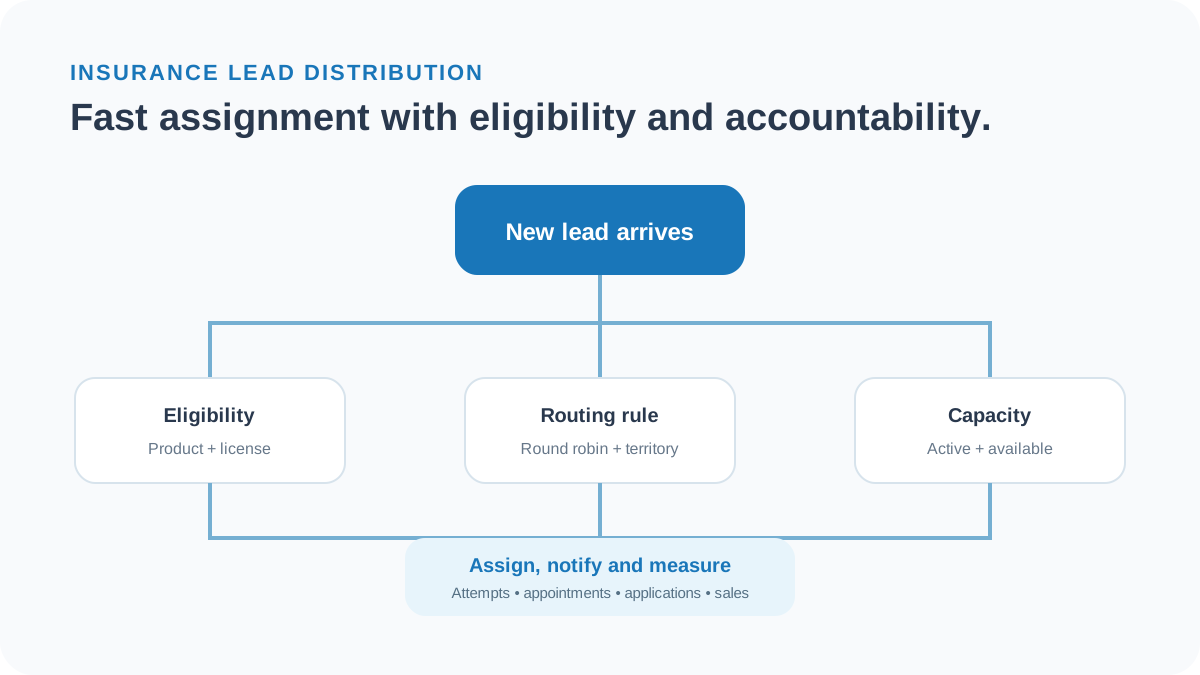
Lead distribution is an operating decision
When an insurance agency buys or generates leads, the first operational question is who receives each opportunity. Slow manual assignment wastes intent. Blind automation can be just as damaging when it sends leads to inactive, unlicensed or overloaded agents.
Insurance lead distribution software should route quickly while enforcing the agency's decisions about geography, product, licensing, availability and accountability. The best rule is not always the most complicated. It is the rule that gives each lead a capable owner and makes the result visible.
Round-robin distribution
Round robin assigns each new lead to the next eligible agent in sequence. It is simple, predictable and generally perceived as fair when agents have similar skill, territory and capacity.
The weakness is that equal distribution can hide unequal execution. If one agent responds immediately and another ignores the CRM for two days, treating them as equally eligible does not protect the opportunity. Round robin should include active-status, licensing and capacity controls.
Territory-based routing
Territory routing assigns leads according to state, county, ZIP code or another geographic rule. It is useful for face-to-face agents, local-number strategies and agencies with protected markets.
Territory data has to be maintained. An agent may be licensed statewide but only willing to drive within three counties. Another may sell remotely across several states. The routing system should reflect the actual operating territory rather than an outdated roster.
Product and licensing rules
A Medicare inquiry should not route to a life-only producer. A Final Expense lead should not be assigned into a state where the agent is unlicensed. Product, carrier appointment and state eligibility should be part of the routing decision where relevant.
Software can enforce the rules entered by the agency, but management remains responsible for accurate licensing and appointment information.
Capacity and availability routing
An active agent can still receive too much volume. Capacity rules can limit daily or weekly assignment, pause an agent who is unavailable and redirect opportunities when a threshold is reached.
This is especially important for real-time leads. Sending thirty inquiries to an agent who can only work ten does not create fairness. It creates wasted acquisition spend and a poor consumer experience.
Performance-informed distribution
Agencies sometimes concentrate leads among agents who demonstrate consistent activity and results. That does not have to mean assigning every lead to the top closer. Performance should be interpreted through enough data and the complete funnel.
An agent with a strong appointment rate may still have weak placement. A new producer may have a small sample but excellent activity. An experienced producer may close well while failing to document outcomes. Use attempts, response time, contacts, appointments, applications, sales and premium together.
A practical pilot can begin with round robin across a defined group, then remove persistently inactive participants or adjust volume once the evidence is clear.
Distribution must connect to notifications
Assignment is not complete until the agent knows the lead exists. Real-time CRM delivery should be paired with email, SMS or in-platform notifications based on the agency's workflow.
Notifications should identify the product and make it easy to open the correct record. The system should also preserve the assignment timestamp so management can measure speed to first activity.
Reassignment needs a clear policy
Agencies should decide when a lead can be reassigned. Possible triggers include no first attempt within a defined period, agent absence, licensing errors or an explicit management decision.
Automatic reassignment can create duplicate contact if the first agent worked outside the CRM. That is another reason activity documentation matters. Reassignment rules should protect the consumer from receiving conflicting calls and protect the agency from internal ownership disputes.
What agency owners should measure
Distribution reporting should answer whether leads were delivered, acknowledged, attempted and advanced. The agency should be able to compare activity and outcomes by agent, campaign, product and territory.
These reports turn lead routing into an improvement system. Management can coach weak openings, adjust capacity, narrow a territory or remove inactive agents based on evidence instead of frustration.
- Leads assigned by agent
- Time to first attempt
- Attempts per lead
- Contact and appointment rates
- Applications and sales
- Premium and placement
- Unworked and reassigned leads
Compare distribution platforms by workflow
LeadSquared, LeadAssign and Phonexa are examples of platforms an agency may evaluate for routing or lead-management infrastructure. GoHighLevel can be customized for assignment workflows, while AgencyBloc approaches the problem from broader agency management. RiseGen's advantage is that routing is not an isolated layer. The agency can acquire or ingest the lead, assign it by round robin or directly, notify the agent, see the CRM activity and connect the outcome to applications, sales and premium inside the same insurance platform.
RiseGen Agency Mode connects lead ordering and ingestion with round robin or direct assignment, notifications, agent CRM activity and production outcomes. That lets management evaluate both the distribution rule and what happened after delivery.
Start simple and earn complexity
A ten-agent agency does not need an algorithm it cannot explain. Begin with eligibility, territory, active status and capacity. Use round robin when the group is genuinely comparable. Add performance-informed decisions only after enough activity has been documented.
The objective is not perfect mathematical fairness. It is responsible stewardship of purchased opportunities, clear expectations for agents and better visibility for management.
Frequently asked questions
What is insurance lead distribution software?
It is software that assigns new insurance opportunities to eligible agents based on rules such as round robin, geography, product, licensing, capacity or performance.
Is round robin the fairest way to distribute leads?
Round robin is fair when eligible agents have similar capacity and activity. It can waste leads when inactive or overloaded agents remain in the rotation.
Can leads be routed by county?
Yes. Many systems can route by state, county or ZIP code when that geography is included in the lead record and routing configuration.
Does RiseGen support agency lead distribution?
Yes. RiseGen Agency Mode supports team assignment workflows, agent notifications, activity visibility and connected production tracking.
Connect lead distribution to agent accountability
See how RiseGen Agency Mode routes opportunities and keeps activity and outcomes visible after delivery.
Explore agency toolsThis article provides general business and educational information, not legal or compliance advice. Rules vary by product, carrier and state. Verify requirements with the appropriate carrier, agency, regulator or qualified counsel.