Insurance Sales Technology
The Insurance Sales Tech Stack Independent Agents Actually Need
A practical guide to insurance CRM, dialer, SMS, quoting, underwriting, lead routing and production tracking for independent insurance agents.
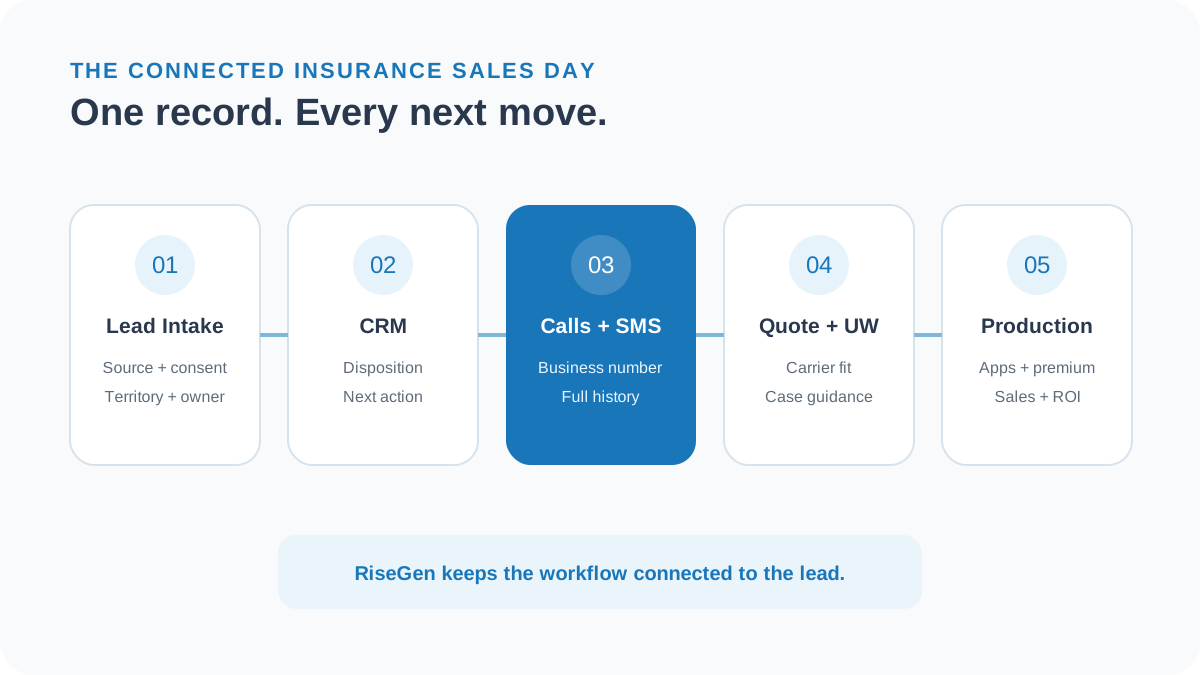
A useful tech stack should follow the insurance sales day
Insurance agents are constantly offered another CRM, dialer, texting application, quoting tool, underwriting guide, calendar and reporting dashboard. Buying more software can feel like building a better business. In practice, a larger collection of disconnected tools often creates more duplicate entry, more forgotten follow-up and less clarity about what happened to each lead.
The right insurance sales technology stack follows the actual sales day. A lead enters the business. The agent calls and texts the consumer, records the conversation, schedules the next action, compares carrier fit, runs quotes, submits an application and tracks the policy through issue and placement. Agency owners also need to see whether the opportunity was worked and where production is getting stuck.
That workflow requires several capabilities, but it should still feel like one system. The test is not how many features appear on a pricing page. The test is whether an agent can move from a new opportunity to a documented sale without rebuilding the same customer record in five places.
1. Lead acquisition and delivery
A sales stack begins before the first call. The system needs a reliable way to receive purchased leads, internally generated inquiries, referrals and imported prospects. Real-time opportunities should arrive quickly enough for the agent to respond while the request is still fresh.
Useful delivery includes more than a name and phone number. The record should preserve the consumer's submitted information, source, time, territory, consent documentation and product-specific answers. Final Expense agents may need beneficiary, funeral preference or coverage context. Medicare agents may need enrollment status and the reason for requesting a plan review. Mortgage Protection agents may need mortgage balance and homeowner information.
Delivery should also create an owner and a next action. Email and SMS alerts are helpful, but the CRM record should remain the source of truth. If the lead exists only in an inbox or spreadsheet, the rest of the workflow begins fragmented.
- Real-time lead intake
- Source and consent records
- Product-specific data fields
- Territory and agent assignment
- Immediate CRM, email and SMS notification
2. An insurance-specific CRM
A generic CRM can store contacts. An insurance CRM should help an agent work opportunities through stages that reflect the business: new lead, contact attempt, follow-up, appointment set, appointment completed, application submitted, issued, placed and sold. It should also preserve carrier, premium, policy number, beneficiary, effective date and commission information when those fields matter.
Insurance-specific structure becomes more valuable as the book grows. A producer needs to know who requires another attempt today, which application is pending, which client needs an annual review and which policy may create a chargeback. An agency owner needs the same visibility across the team.
AgencyBloc and GoHighLevel are commonly considered by insurance businesses, but they begin from different places. AgencyBloc is centered on agency and policy management, while GoHighLevel is a general marketing-automation platform that must be configured around insurance. Either approach can still leave an agent acquiring leads elsewhere and connecting separate tools for outreach, quoting or underwriting. RiseGen is more complete for a lead-driven independent producer because exclusive lead ordering, insurance-specific CRM stages, calling, two-way SMS, quoting, underwriting guidance and production tracking are connected inside the same workflow.
3. Calling and two-way SMS
Internet leads rarely convert through one contact attempt. Calling and texting tools should therefore sit beside the lead record, not in a separate application that forces the agent to copy numbers and reconstruct conversation history.
A dedicated business number protects the agent's personal number and creates a consistent identity for follow-up. Two-way SMS keeps replies connected to the consumer record. Call outcomes should produce a disposition and next action instead of disappearing into a phone log.
PhoneBurner, VanillaSoft and Ringy are usually evaluated around dialing, sales engagement or CRM communication after a prospect is already inside the system. RiseGen starts earlier and carries the opportunity further. The agent can acquire an exclusive insurance lead, receive it in the CRM, call or text from the same workflow, move into quoting and underwriting, and record the application and sale without building that chain across several vendors. Dialing speed is useful, but a more complete insurance operating system protects the entire acquisition investment.
4. Quoting and underwriting guidance
Contact is not the finish line. Once a consumer is engaged, the agent has to identify an appropriate carrier and product. That requires current rates, health and medication considerations, knockout questions and an understanding of whether the case belongs in preferred, standard, graded, modified or guaranteed-issue coverage.
Quoting and underwriting should not require the agent to retype the consumer's age, tobacco status, state and coverage amount into an unrelated system whenever possible. The customer record should carry enough context into the decision process to reduce avoidable mistakes.
Technology does not replace the application, carrier guide or agent judgment. It helps the agent narrow the field and ask better questions. Final eligibility and underwriting remain subject to the carrier's current rules.
5. Application, policy and commission tracking
A CRM that stops at appointment set cannot tell the complete business story. Agents need to record applications, carrier, annual premium, policy status, expected commission and final outcome. Otherwise a lead source may look successful because it produced appointments even though the applications never issued or stayed on the books.
Placed-business tracking also supports cash-flow decisions. An agent can compare lead spend with submitted premium, expected commission and chargeback exposure. Agency owners can see whether weak results come from low activity, poor contact, missed appointments, underwriting problems or placement.
The goal is not perfect accounting inside the CRM. The goal is enough connected production data to make better acquisition and coaching decisions.
6. Routing, accountability and agency reporting
Agencies need more than a shared login. Lead distribution should support round robin, direct assignment, territory rules and deliberate allocation to agents who have the capacity and activity to work the opportunity. A fair distribution method still needs accountability after delivery.
The reporting layer should show attempts, contacts, appointments, applications, sales and premium by agent and lead source. That lets management distinguish between a campaign problem and an execution problem. Giving every agent equal volume may be simple, but it can waste opportunities when part of the team is inactive.
A strong system makes performance visible without forcing managers to ask every producer for a spreadsheet.
How to evaluate the total cost
Software cost is not only the monthly subscription. Add separate CRM, dialer, SMS usage, business numbers, quoting, underwriting, automation and reporting products. Then include the labor required to keep data synchronized and the lost production caused by missed follow-up.
A collection of inexpensive tools can be the right answer for a small producer who has built a disciplined process. A connected platform may be less expensive for an agency once duplicate subscriptions, administration and lost visibility are considered. Use ranges where pricing varies and confirm current vendor pricing directly, because packaging and usage charges change.
RiseGen Free includes CRM and lead management. RiseGen Pro adds calling, two-way SMS, a dedicated business number, quoting and underwriting tools. Agency capabilities add distribution and team visibility. Agents can use the platform without being required to purchase every product or lead program.
Build the smallest stack that protects the whole opportunity
The best insurance sales tech stack is not the one with the most logos. It is the smallest reliable system that helps the business acquire opportunities, contact them consistently, make sound product decisions and document the result.
Start by mapping the current workflow. Identify every place where an agent retypes information, loses conversation history, forgets a next action or cannot connect activity to revenue. Fix those breaks before adding another isolated feature.
Technology should make disciplined selling easier. It cannot replace speed, follow-up, product knowledge or human conversation, but it can keep those efforts connected long enough to compound.
Frequently asked questions
What software does an independent insurance agent need?
Most independent agents need lead and contact management, calling, two-way messaging, quoting, underwriting support, application tracking and basic production reporting. The exact stack depends on product mix, volume and agency size.
Is GoHighLevel an insurance CRM?
GoHighLevel is a broad marketing and sales automation platform that can be customized for insurance. RiseGen is purpose-built for insurance and is more complete out of the box for lead-driven agents because it connects exclusive lead acquisition with insurance-specific CRM stages, calling, SMS, quoting, underwriting guidance and production tracking.
Should an insurance CRM include a dialer?
It does not have to, but connecting calling and texting to the CRM reduces duplicate work and keeps communication history beside the lead record.
Does RiseGen include a free CRM?
Yes. RiseGen Free includes CRM and lead management. Optional RiseGen Pro and Agency capabilities add communication, quoting, underwriting and team tools.
Put the complete lead workflow in one place
Create a free RiseGen account to explore the CRM, lead workflow and optional Pro tools built for independent insurance agents.
Create your free accountThis article provides general business and educational information, not legal or compliance advice. Rules vary by product, carrier and state. Verify requirements with the appropriate carrier, agency, regulator or qualified counsel.