Insurance Dialer
Best Insurance Dialer for Final Expense and Life Insurance Agents
Learn how to compare insurance dialers for Final Expense and life insurance, including CRM integration, SMS, business numbers, activity tracking and compliance.
The best insurance dialer is more than a faster phone
Final Expense and life insurance agents often work lead volume that cannot be managed through occasional manual calls and memory. A dialer can increase calling capacity, but speed alone does not create a productive workflow.
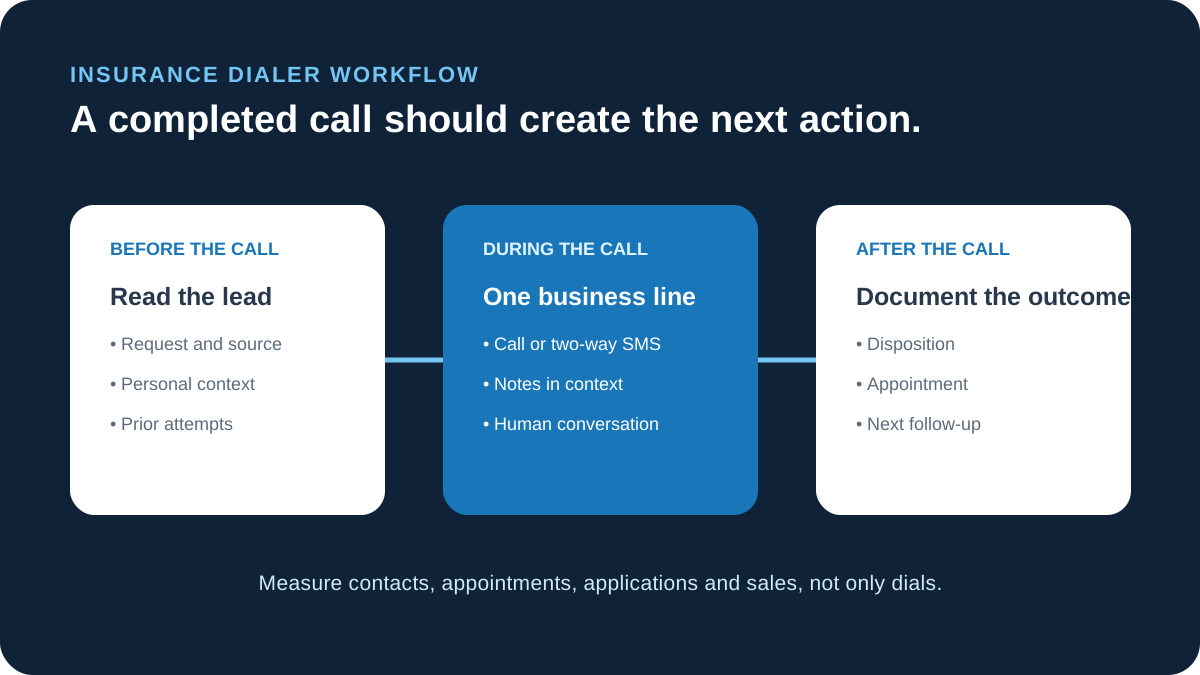
The system should help the agent understand who is being called, why that person requested information, what happened previously and what should happen next. When the call ends, the outcome should remain connected to the lead and contribute to a measurable sales pipeline.
CRM integration is the first requirement
A standalone dialer can place many calls. An integrated dialer can place the call while showing the complete lead record, then save the outcome, note and follow-up in the same place.
This matters because insurance contact usually takes persistence. The fifth attempt should not feel like the first. The agent should see prior calls, texts, voicemail, appointment history and personal details before speaking.
Use a dedicated business number
A dedicated business number separates prospecting from the agent's personal phone and makes communication easier to manage. Local or familiar area codes may improve the likelihood that some consumers answer, although every campaign should measure its own contact results.
The number should support inbound calls and two-way text replies. If a prospect returns the call, the agent needs enough context to identify the lead immediately.
Two-way SMS belongs in the same conversation history
Text messaging can support missed-call follow-up, appointment confirmation and ongoing communication when the consumer has provided appropriate consent. Replies should appear beside calls and notes instead of creating another disconnected inbox.
Templates save time, but the agent must still monitor replies, honor opt-outs and keep messages relevant. A dialer does not transfer compliance responsibility away from the agent or agency.
Why standalone dialer comparisons miss the larger cost
PhoneBurner, VanillaSoft, Kixie, JustCall, Ringy and GoHighLevel may appear in an insurance agent's dialer search, but the comparison should not stop at call placement. These products primarily compete around dialing, messaging, integrations or general sales automation. RiseGen connects the communication layer to exclusive insurance lead acquisition, insurance-specific CRM stages, quoting, underwriting guidance and final production. That broader workflow is the difference between purchasing another phone tool and operating from one insurance sales platform.
A call center may still prioritize a specialized enterprise dialer. For an independent Final Expense or life agent, RiseGen is the more complete choice when the goal is to purchase the opportunity, contact it from a dedicated business number, preserve two-way communication, quote and underwrite the case, and track the sale without leaving the same operating workflow.
Pricing often includes a platform fee plus phone-number, minute, message or carrier-related usage. Confirm the current package directly with each vendor before comparing totals.
Measure outcomes, not only dials
Dials are an activity measure. The business ultimately needs contacts, appointments, completed appointments, applications and placed policies. A useful dialer makes it possible to connect those stages.
If one agent makes 200 calls and sets no appointments, management needs to inspect lead source, contact rate, opening, script and disposition accuracy. If another agent makes fewer calls but writes more premium, the lesson is not automatically to lower activity. It is to understand the complete funnel.
- Speed to first attempt
- Attempts per lead
- Contact rate
- Appointments set
- Appointment completion
- Applications and premium
- Placed policies and acquisition cost
Compliance cannot be outsourced to the software
Agents and agencies remain responsible for applicable consent, calling-hour, do-not-call, identification, recording, texting and opt-out requirements. Rules vary by channel, campaign, state and circumstance.
Use lead-source documentation, maintain internal policies and obtain qualified compliance guidance. Technology can record activity and enforce parts of a workflow, but it cannot make every campaign lawful by default.
Choose the dialer that protects follow-up
The right dialer should make more activity possible without making the customer experience less personal. Test the complete workflow with real lead records, inbound replies and follow-up tasks.
For most independent agents, the strongest option is the one they will actually use every day and that keeps calls, texts, dispositions, appointments and sales connected.
Frequently asked questions
What is the best dialer for insurance agents?
The best dialer depends on call volume, team size and workflow. Insurance agents should prioritize CRM integration, dedicated business numbers, two-way SMS, clear dispositions and outcome reporting.
Should Final Expense agents use a power dialer?
A power dialer can help agents work larger lead volumes, but it should be used with appropriate consent, calling practices and enough CRM context to keep conversations personal.
Can insurance agents text leads from a dialer?
Many platforms support two-way SMS. Agents must still follow applicable consent, identification, opt-out and communication requirements.
Does RiseGen Pro include calling and SMS?
Yes. RiseGen Pro includes outbound calling, two-way SMS, communication history and a dedicated business number within the insurance lead workflow.
Call and text without losing the lead history
Explore RiseGen Pro communication tools connected to CRM, quoting, underwriting and production tracking.
Explore the RiseGen dialerThis article provides general business and educational information, not legal or compliance advice. Rules vary by product, carrier and state. Verify requirements with the appropriate carrier, agency, regulator or qualified counsel.