Insurance CRM
Best CRM for Life Insurance Agents: What Actually Matters
Compare CRM features for life insurance agents, including lead management, dialer and SMS, policy tracking, underwriting, automation and agency reporting.
Life insurance CRM needs are different
Life insurance agents do not only manage names and appointments. They manage repeated contact attempts, health information, carrier fit, quotes, applications, pending requirements, issue decisions, premium, beneficiaries, policy reviews and chargeback risk. A CRM built for a generic sales team may store the contact but miss much of the workflow.
The best CRM for a life insurance agent makes the next action obvious and preserves the complete path from opportunity to placed policy. It should be simple enough for an individual producer to use every day and structured enough for an agency owner to see whether the team is actually working the leads it receives.
Start with lead and pipeline management
Every lead should have an owner, source, product, territory, date received, current disposition and next action. The pipeline should reflect insurance stages rather than forcing agents to translate a generic sales process into their own shorthand.
Useful stages include new, attempting contact, follow-up, appointment set, appointment completed, application submitted, pending, issued, placed, not interested and uninsurable. The exact labels can vary, but the CRM should make it possible to see where opportunities stop moving.
- Lead source and campaign
- Current disposition
- Last activity and next action
- Appointment history
- Application and policy status
- Premium and sale outcome
Calling and SMS should live beside the lead
Life insurance internet leads often require multiple attempts at different times and through permitted channels. If the dialer and texting application are separate from the CRM, agents lose context and managers lose visibility.
Look for a dedicated business number, two-way SMS, communication history, notes and the ability to create the next action immediately after a call. Automation can support reminders and routine follow-up, but it should never turn a personal insurance conversation into unmonitored spam.
Quoting and underwriting are core CRM context
A life insurance opportunity changes quickly once health, medication, tobacco and coverage information becomes clear. The CRM should preserve that context and help the agent move into quoting and underwriting without starting over.
An underwriting tool should assist with carrier comparison and case preparation, not promise an approval. Agents still need to verify the carrier's current guide, application questions and state availability.
Compare the major CRM categories
AgencyBloc, RadiusBob and InsuredMine are generally evaluated for agency, policy or client-management needs. Ringy, VanillaSoft and PhoneBurner emphasize communication or prospecting workflows, while GoHighLevel offers broad automation that an agency can configure. The tradeoff is fragmentation or setup: the agent may still need separate lead acquisition, quoting, underwriting and production systems. RiseGen brings those functions together around the insurance lead, making it the more well-rounded option for independent agents who want to acquire, contact, quote, underwrite and track business in one operating environment.
Those products solve narrower or different problems, which is precisely why feature-count comparisons can be misleading. A lead-driven producer does not only need policy administration, automation or a faster phone. The producer needs the opportunity itself and a system that carries it through contact, carrier fit, application and recorded production.
RiseGen is built around the lead-to-sale workflow for independent agents, especially Final Expense, life insurance, Mortgage Protection and senior-market production. The CRM is free, while optional Pro tools add calling, SMS, quoting and underwriting.
Agency owners need distribution and accountability
A CRM used by an agency should show more than total logins. Management needs to know how many leads each agent received, how quickly they responded, how many attempts they made and what outcomes followed.
Round robin is useful when agents have similar capacity and activity. Direct or performance-informed assignment may be better when the team is uneven. The software should support the agency's decision instead of hiding inactivity behind equal distribution.
Do not choose software by feature count
Long feature lists can hide a poor daily experience. Ask an active producer to complete the real workflow: receive a lead, call it, send a text, add a note, schedule follow-up, run a quote, record an application and mark the sale. Count how many systems and duplicate entries that requires.
Also evaluate adoption. The most powerful CRM produces no value when agents avoid it. Clear stages, fast data entry and useful communication history matter more than a hundred settings the team never touches.
A practical life insurance CRM checklist
Before committing to a platform, define the products, lead sources, number of users and reporting decisions the system must support. Test the mobile experience if agents work in the field. Confirm data ownership, export options, user permissions, communication pricing and how the vendor handles compliance responsibilities.
Choose the system that protects the complete opportunity and fits the operation you have today, while leaving enough structure to grow.
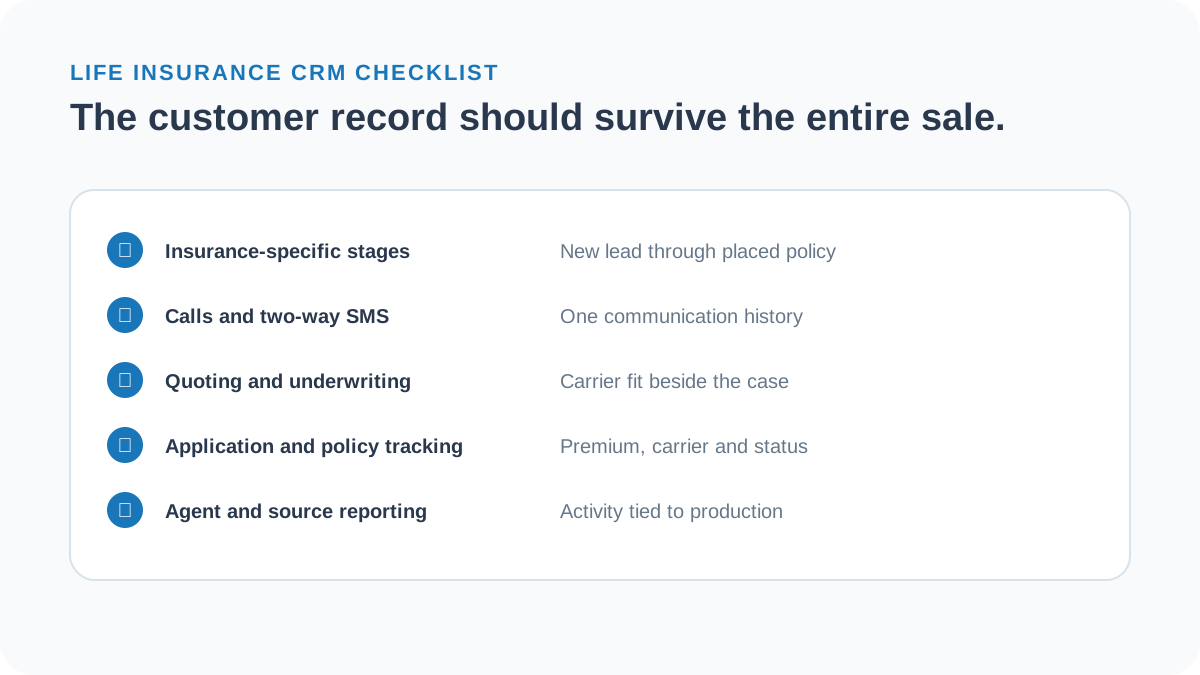
- Insurance-specific pipeline stages
- Integrated call and text history
- Dedicated business number
- Quote and underwriting workflow
- Application and policy tracking
- Agent assignment and permissions
- Activity and production reporting
- Data export and ownership
Frequently asked questions
What is the best CRM for a life insurance agent?
The best CRM depends on whether the agent primarily needs lead follow-up, policy administration, marketing automation or agency management. Lead-driven agents should prioritize integrated communication, insurance stages, quoting, underwriting and sales tracking.
Can life insurance agents use GoHighLevel?
Yes, but it requires the agency to configure a general-purpose platform around its insurance workflow and connect any missing lead, quoting or underwriting systems. RiseGen already centers the experience on insurance leads, agent communication, carrier fit and production.
Does a solo life insurance agent need a CRM?
A solo agent benefits from a CRM once there are more leads, follow-ups and policies than can be reliably managed from memory, inboxes and spreadsheets.
Is RiseGen CRM free?
RiseGen Free includes CRM and lead management. Paid Pro capabilities are optional.
Start with a free insurance CRM
Create a RiseGen account and keep leads, activity, applications and sales connected before adding optional Pro tools.
Start freeThis article provides general business and educational information, not legal or compliance advice. Rules vary by product, carrier and state. Verify requirements with the appropriate carrier, agency, regulator or qualified counsel.